





Everyone hates wasted spaces, especially in kitchens. If your kitchen includes an inside corner, learn some ways to effectively and conveniently use that space.
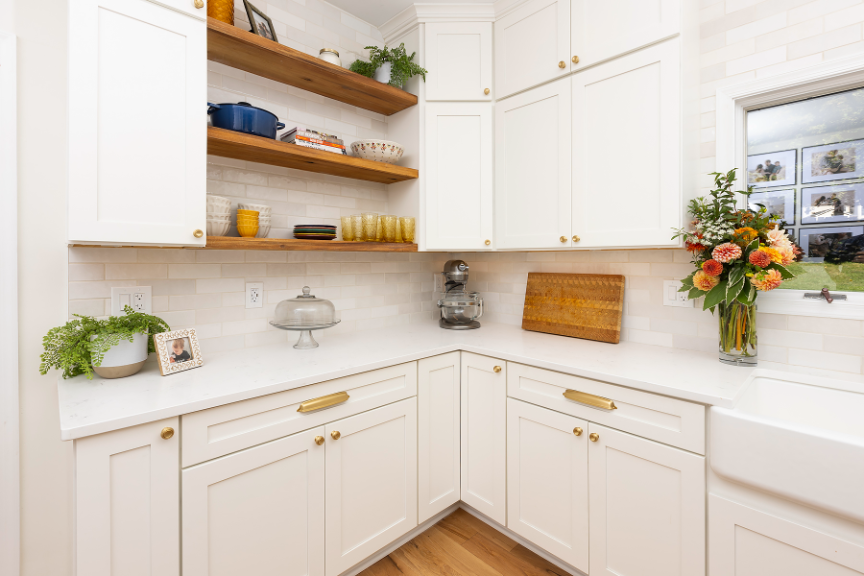
One of the challenges in creating an effective kitchen design is knowing how to best utilize the space in an inside corner. Overcoming that challenge does not need to be stressful, however. There are lots of options to choose from, and there is certainly a solution that will work great in your kitchen.
What is an “inside corner”? Many kitchens form an “L” or “U” shape, and the inside corner is the acute space where the two sides meet together. Usually, that angle is 90 degrees, though not always; it all depends on the design of the whole house, and how the kitchen fits into that design.
The challenge of these inside corners is that their depth usually creates a narrower-than-normal point of access to a larger-than-normal cavity. The goal is to find a way to utilize that cavity, while staying within budget, and without making the kitchen feel constricted.
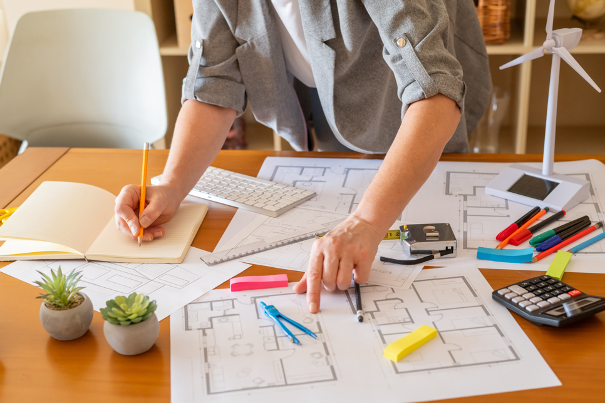
Two key factors play into the designing of a kitchen’s inside corner. The first is the type of cabinet to be used. The second is any hardware or accessories that can help maximize the cabinet’s interior space. We have already covered types of accessories and hardware to use. For the next installment in our series. we will discuss cabinet types. We will focus base cabinets but the same approach can be applied to wall cabinets, on a on a smaller scale.
Corner cabinet options
Corner pantry
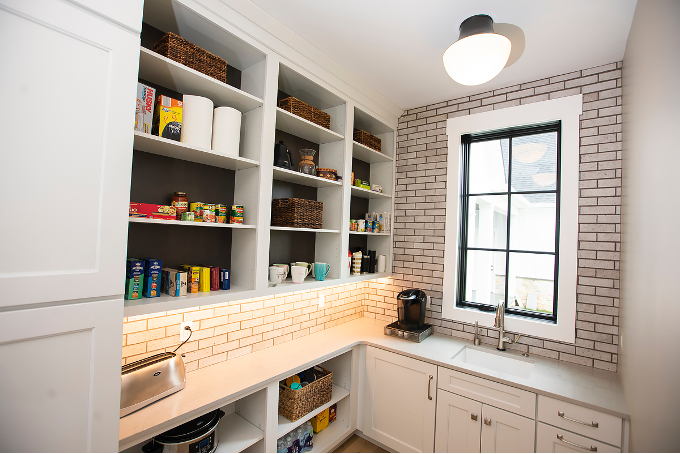
A corner pantry is not a “cabinet” in the technical sense. It is, literally, a separate room, a walk-in closet that is built into the kitchen’s inside corner. It breaks the lines of the kitchen into two, straight segments, and creates clean edges on either side against which the kitchen’s cabinets and countertops are butted.
The advantages of a corner pantry are immediately obvious. Warehouse-style food shopping is increasingly popular with individual consumers today. That means, however, that instead of buying just one can of beans for tomorrow’s dinner we are buying an entire case of bean cans that will last us for several months. Where are we going to store all those extra cans of beans? Multiply that scenario by all the products that we think are necessary to have on hand, and we have an instant need for considerable storage space. That’s what corner pantries are best at.
Corner pantries are also very convenient and ergonomic. Who wants to be running out to and back from the garage, or up and down the stairs to the basement, when what you need can be readily available right where you are? And who wants to contort themselves to reach something that was accidentally pushed just out of reach into the back of a corner base cabinet, when you can just open a door, walk in, and take what you need off the shelf that is right in front of you?
The disadvantages of a corner pantry are equally obvious, however. The biggest one is just that: its size. It eats up an enormous amount of space. Smaller kitchens simply cannot accommodate something that large. And it is not very efficient: its footprint is usually disproportionate to its amount of usable storage.
A corner panty may pose other problems as well. What you gain in storage space you lose in countertop space for food preparation. Care must also be taken to ensure that appliances (e.g. refrigerator doors) do not interfere with the pantry’s entryway.
As with every part of the kitchen, a corner pantry’s effectiveness is tied both to how it is constructed and how it is used. Built well, and used well, it can be a great way to create a clean, clutter-free, and convenient kitchen experience.
Base Blind Cabinet
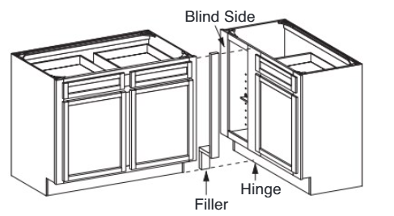
A base blind cabinet is the simples, and most common, way to construct a kitchen’s inside corner. Base blind cabinets are simple, straight cabinets, in many respects just like other base cabinets. Their main difference is that the side that goes into the corner area has no door, so that the base cabinet on the adjacent wall can butt up against it. However, the space within a base blind cabinet is fully usable.
Base blind cabinets have some obvious advantages. Their simplicity makes them cheap to build and easy to install. They have the narrowest possible footprint and do not take more space away from the kitchen. Furthermore, because they are simple base cabinets, they do not require extra countertop material to cover them.
But base blind cabinets also have an obvious disadvantage, as their name implies: it is very hard to see what is in the back of the cabinet, and to access it usually requires some uncomfortable reaching and contorting. If what is stored there is only needed occasionally, it is not so bad. However, you wouldn’t want to have to get things in and out of it on a daily basis. Certain hardware and accessory options can overcome this limitation somewhat, but those also usually impact the way the available space can be used.
In summary: Base blind cabinets provide a simple and inexpensive way to maintain the maximum use of the kitchen’s inside corner space, though they do so at the expense of convenience and efficiency.
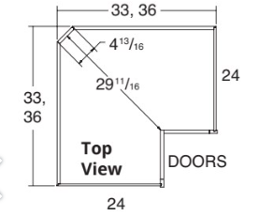
Base Corner Corner Cabinet
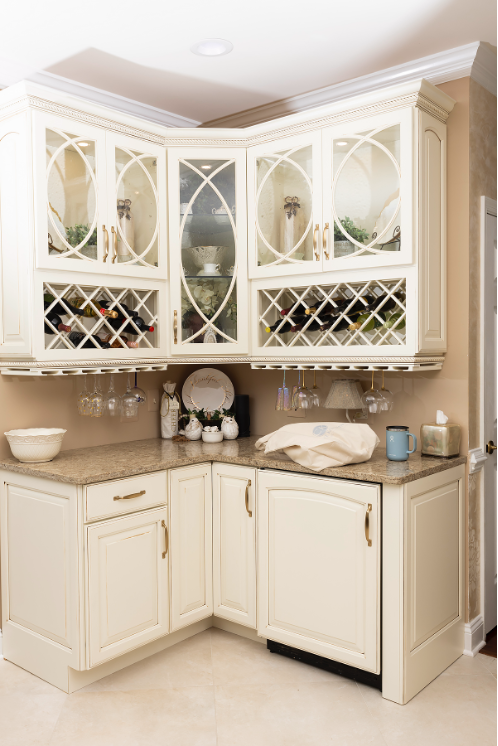
A base corner corner cabinet (a strange name, we know) is a single cabinet that fills the area created by the angle in the wall joint (usually 90 degrees). The entire interior of the cabinet is available for storage, and often a specially hinged door is mounted in the corner itself which allows for easier visibility into and access to that space.
That easier visibility and access is a major advantage of a base corner corner cabinet. Additionally, since its footprint is the same as two simple base cabinets butted against each other, there is no additional loss of kitchen area, which is especially important if the kitchen is small. Likewise, it also does not require extra countertop material.
The disadvantages of a base corner corner cabinet center primarily on its cost to manufacture and install. Because it is not a simple box but creates an angle, it requires more material and a stronger support infrastructure. It also can be a bit more challenging to ensure that it aligns properly with the rest of the cabinets. Finally, to use it well will still likely require extra hardware which will increase the cost and potentially reduce the available space.
In summary: Base corner corner cabinets allow for easier access to and use of a kitchen’s inside corner without encroaching on the main kitchen area, though they are usually more expensive and require extra hardware to make them fully useful.
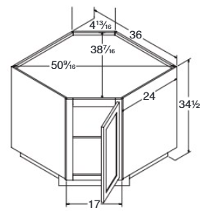
Base Angle Corner Cabinet
Base angle corner cabinets also completely fill the area of the wall joint, keeping their interior cavity completely open and available. They do so, however, by creating a third face that “bridges” between the two main faces meeting in the corner. The door is typically in that third face.
Base angle corner cabinets are usually massive, which means that their interior space is also massive. Depending on their design specifics (number of shelves, size of the door face, etc) their interior space can allow for either more or larger items to be stored, and they do so without needing a lot of bodily contortions to access them. If the kitchen design calls for a sink in the corner, a base angle corner cabinet is the natural way to make that happen.
However, their size, plus all the angles they create, require a lot of materials and millwork to manufacture. Naturally, that makes base angle corner cabinets much more expensive. They also create a huge footprint, and the amount of space they consume would be a drawback in a smaller kitchen. That larger footprint also requires their countertops to be larger, which, in turn, drives the cost up even further.
In summary: Base angle corner cabinets “soften” the look of the kitchen’s corners and create a significantly larger space for storage, but they are expensive and encroach into the kitchen’s workspace.
Open Shelves
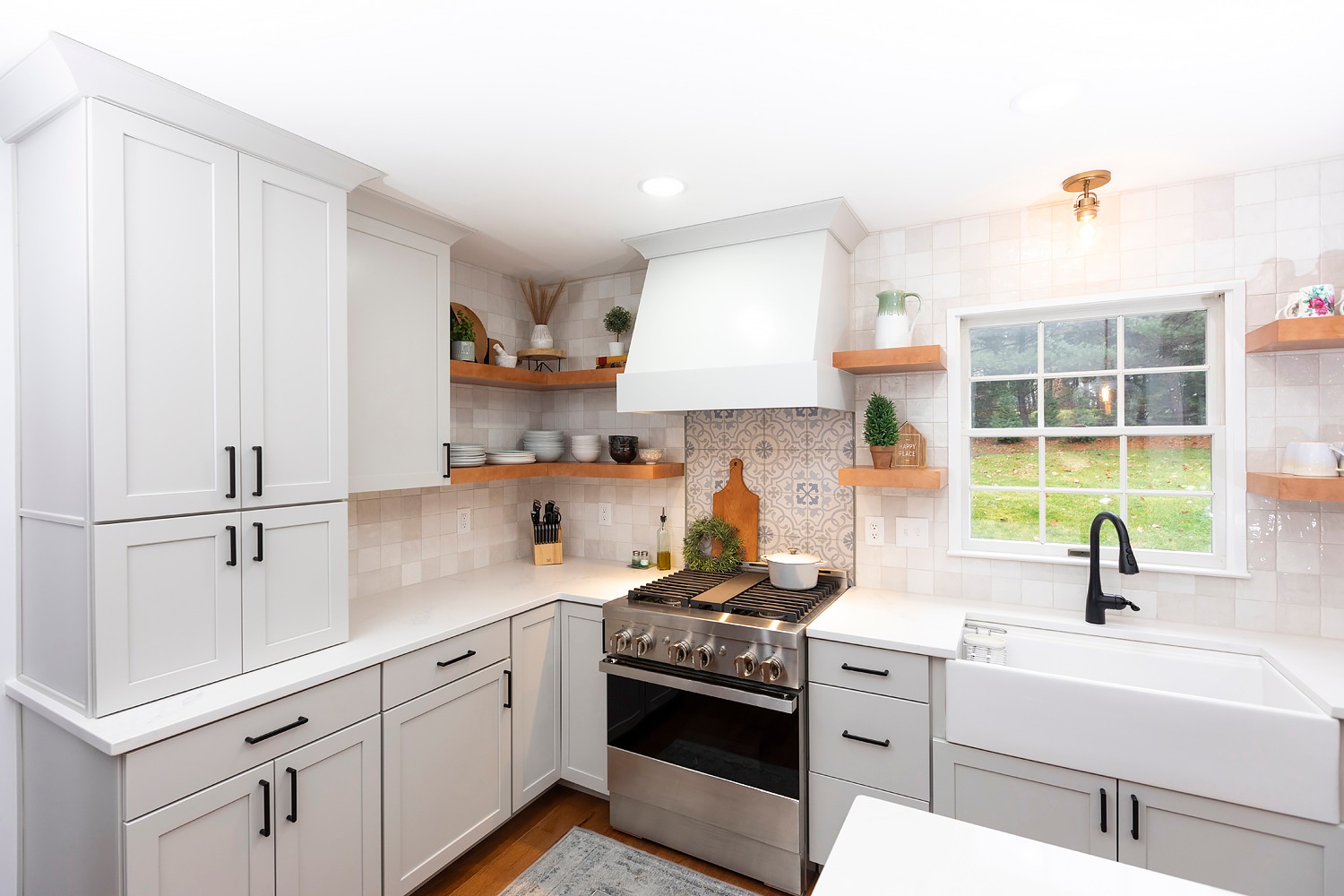
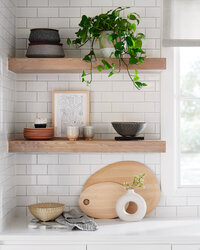
In some situations, an option that may work well for wall cabinets would be to not have actual cabinets at all, just open shelves. Obviously, open shelves eliminate the problem of visibility and access. They may even be more aesthetic. Their primary problem would be linked to how they are used, and the fact that the items stored on them would be more vulnerable to dust or greasy kitchen splatters.
Void Corner
We would be remiss to not include in this lineup the possibility of a “nothing” cabinet – literally, a void. The idea of having any space in the kitchen completely inaccessible and unusable seems counterintuitive, especially in our storage-hungry way of living. Even inconvenient and inefficiently used space seems like a better option than no space at all.
Void corners would not be the best option in most scenarios. But there are some cases where it might, in fact, make all the difference. This would usually be in smaller kitchen spaces where, for example, the placement of appliances must be nestled into the corner such that there simply is no good way to fit a functional cabinet in the space.
Find Your Solution!
There are many options available to use a kitchen inside corner well, and within any budget. Our design professionals at Carefree Kitchens have years of experience creating kitchen spaces that are not just useful, but beautiful – kitchens that our clients love. If you would like to consult with a member of our team, contact us today.







+ Show / Hide Comments
Share to: